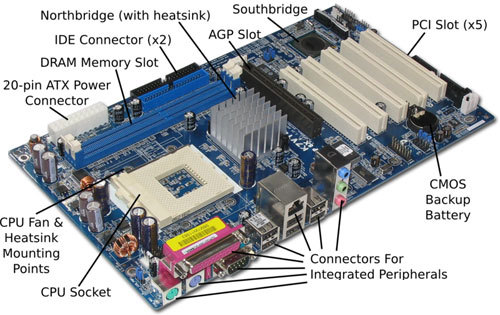
 The motherboard is the main circuit board of the micro-computer. The motherboard contains the connecters for attaching additional boards. Typically, the motherboard contains the CPU, BIOS, memory, mass storage interfaces, serial and parallel ports, expansion slots, and all the controllers required to control standard peripherical device, such as the display screen, keyboard, and disk drive. Collectively, all these chips that reside on the motherboard are known as the motherboard's chipset.
 On most PCs, it is possible to add memory chips directly to the motherboard. You may also be able to upgrade to a faster PC by replacing the CPU chip. To add additional core features, you may need to replace the motherboard entirely.


 Floppy disk is a soft magnetic disk. It is called floppy because it flops if you wave it (at least, the 5??-inch variety does). Unlike most harddisk, floppy disks (often called floppies or diskettes) are portable, because you can remove them from a disk drive. Disk drives for floppy disks are called floppy drives. Floppy disks are slower to access than hard disks and have less storage capacity, but they are much less expensive. And most importantly, they are portable.
 A hard disk is part of a unit, often called a "disk drive," "hard drive,